
Driving at highway speeds should feel smooth, confident, and predictable. Once you reach cruising speed, your vehicle should track straight, respond calmly to steering input, and feel firmly planted on the road. When that sense of stability disappears, even slightly, every trip can become incredibly stressful.
Some drivers describe the sensation as floating, wandering, shaking, or constantly needing to correct the steering wheel to stay in their lane. What makes this issue particularly concerning is that it often doesn’t appear during city driving. Around town, the vehicle may feel completely normal. The problem only becomes noticeable once speeds increase, leading many drivers to assume it’s simply caused by crosswinds, road conditions, or rough pavement.
In reality, a vehicle that feels unstable at highway speeds is warning you that something inside its tracking or stabilization network isn’t working as it should. Highway speeds amplify small imperfections. A minor issue that goes unnoticed at 30 or 40 miles per hour becomes obvious at 65 or 70 mph because tires rotate faster and suspension components experience significantly greater kinetic loads.

Centrifugal Tire Forces and The “Floaty” Suspension Sensation
Since tires are the only part of the vehicle that actually touches the asphalt, they play a major role in overall stability. Uneven tread wear, improper inflation, or an internal steel belt separation can distort how the footprint contacts the road. At high speeds, centrifugal forces magnify even tiny tire variations, creating a wandering or wobbling sensation.
While some tire issues create an obvious steering wheel vibration, others simply make the chassis drift. Keeping your tire pressures balanced during standard routine auto maintenance is an essential baseline step to prevent this high-speed lane drift. Your suspension system is also responsible for keeping those tires firmly connected to the ground.
Shocks and struts control body rebound over bumps and dips. As these dampening components wear out, their ability to check vertical movement drops. Technical chassis analysis papers published by SAE International confirm that worn shock valving fails to stabilize the vehicle’s aerodynamic lift at highway velocities, causing a distinct “floaty” or loose sensation that leaves the vehicle unsettled after driving over bridges or expansion joints. Catching this dampening loss early requires professional auto inspections before a strut fails completely.

Geometric Alignment Drift and Wear in the Steering Rack Links
Proper wheel alignment is crucial for straight-line highway confidence. Geometric alignment angles such as toe, camber, and caster determine the exact axis on which the wheels roll. When these angles fall out of factory specifications due to pothole impacts, the tires actively fight against each other, making the steering wheel feel incredibly vague, disconnected, or non-centered.
Steering system wear creates nearly identical tracking issues. Loose tie rod ends, worn steering gear bushings, or internal steering rack play allow the front wheels to oscillate slightly under high aerodynamic loads. Because these linkages degrade very gradually, many drivers unconsciously adapt to the play by gripping the wheel tighter, completely unaware of how much actual control has been compromised.
There are also several hidden problems that drivers frequently overlook during a casual inspection. For instance, a worn wheel bearing can introduce subtle mechanical play into the hub assembly long before it starts producing a typical humming noise. Similarly, a sticking brake caliper can create continuous, uneven rolling resistance on one corner, pulling the chassis offline. Vehicle safety logs tracked by Consumer Reports indicate that even a loose aerodynamic underbody splash shield can catch high-speed airflow, generating unbalancing buffeting forces that mimic a severe front-end suspension failure.

The Critical Risk of Delayed Chassis Maintenance
Ignoring high-speed instability is a major safety risk. When a vehicle floats or wanders, your physical response windows shrink during emergency avoidance maneuvers or sudden lane changes. Fleet safety metrics compiled by the American Automobile Association (AAA) demonstrate that driving on an unstable chassis puts massive secondary strain on adjacent ball joints and wheel bearings, rapidly turning a minor alignment or balancing fix into an expensive multi-system rebuilding job. If your steering feels sluggish, getting a precise vehicle diagnostics checkpoint run on your steering angle sensors and suspension hardware is highly recommended.
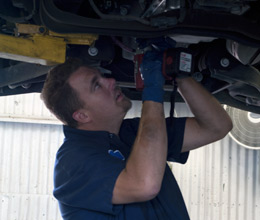
At All Around Auto Repair, our technicians evaluate high-speed instability concerns through a comprehensive systemic approach. We don’t guess; we inspect tire tread uniformity, check wheel balance, verify component play on a lift, and measure tracking geometry to isolate the exact mechanical cause of your floating or shaking symptoms.
Your vehicle should always feel entirely stable, predictable, and easy to control at cruising speeds. If your car has lost its firm connection to the tarmac or requires constant steering steering corrections on flat highways, let our experienced team diagnose the system and restore your factory-grade safety and comfort.
To schedule a computerized wheel balancing or a comprehensive highway safety alignment inspection, please contact All Around Auto Repair today.
📞 (707) 837-0646
📍 1244 Central Ave, Santa Rosa, CA 95401
All Around Auto Repair – Repair. Maintenance. Service. Since 2001.