It’s easy to ignore at first. You’re driving down the road, and you notice the steering wheel isn’t perfectly centered. Maybe the car drifts slightly to the left or right if you loosen your grip. It’s not dramatic. You can still drive normally. You just make a small correction without thinking about it.
Most drivers assume it’s nothing serious. Maybe it’s the road surface. Maybe it’s the wind. Maybe it’s just one of those things cars do over time. So instead of getting it checked, they adjust their driving and move on. But a car that pulls to one side is never random.
It’s a sign that something in your vehicle is no longer balanced the way it should be. And while the issue may feel minor today, continuing to drive this way can lead to a chain reaction of wear, reduced safety, and more expensive repairs over time.

The Disruption of Steering and Wheel Alignment Geometry
When everything is properly aligned and functioning, your vehicle should travel in a straight line with minimal input from the steering wheel. The tires should contact the road evenly, the suspension should distribute weight properly, and the steering system should respond predictably. A pull to one side means that balance has been disrupted.
One of the most common causes of this issue is wheel alignment. Alignment refers to the precise angles at which your wheels are positioned relative to each other and the road. These angles are carefully set to ensure even tire wear, stable handling, and proper steering response. When alignment is off, even slightly, the vehicle may begin to drift. One wheel may point slightly inward or outward compared to the others, creating resistance that pulls the car in a specific direction. Resolving this misalignment usually requires a target adjustment during your routine auto maintenance updates.
The most immediate impact of ignoring this condition is on your tires. When a car pulls to one side, the tires are no longer wearing evenly. Instead of rolling straight, they are being dragged slightly across the road surface. This creates uneven wear patterns that can reduce tire life significantly. Consumer tire studies managed by the U.S. Tire Manufacturers Association (USTMA) show that driving on a misaligned chassis can scrub off valuable tread depth up to three times faster than normal, forcing a premature tire replacement.

Chassis Wear, Loose Linkages, and Braking Vectors
Beyond tire wear, a constant pull also affects your steering system. To keep the car moving straight, you are constantly applying slight counter-pressure to the steering wheel. Over time, this constant load places additional strain on steering components. Parts like tie rods, steering racks, and bushings are designed to operate under balanced conditions. When they are consistently compensating for misalignment, they experience increased wear, which eventually requires advanced vehicle diagnostics to safely locate and isolate.
Suspension components carry the burden of this uneven force as well, accelerating wear in critical parts like control arms, ball joints, and shocks. Furthermore, your braking performance can be directly influenced. If the vehicle pulls to one side while driving, the uneven contact patch between the tires and the asphalt can cause the car to dart or pull abruptly during braking maneuvers. Technical engineering manuals released by SAE International outline how uncorrected tracking issues alter the vehicle’s braking vectors, increasing stopping distances and reducing electronic stability control precision in wet conditions.
In some cases, the pull may not be caused by alignment angles alone. Tire-related issues like uneven tire pressure or internal belt damage can create a drift. Alternatively, a sticking brake caliper can cause one wheel to experience constant mechanical resistance, generating a pulling sensation that requires immediate brake repair and servicing to prevent localized system overheating.

The Danger of Gradual Driver Adaptation
One of the biggest risks of ignoring a slight pull is how gradually it worsens. Drivers adapt without realizing it. You begin to hold the steering wheel at a slight angle out of habit, and your perception of what feels “normal” changes. The problem doesn’t feel urgent because you’ve adjusted your physical driving style to counteract it, but the underlying mechanical issue continues to develop behind the scenes.
Consumer safety reports evaluated by Consumer Reports warn that putting off a minor vehicle tracking issue transforms a simple, cost-effective laser wheel alignment service into an expensive, multi-component replacement job that compromises your vehicle’s entire front-end suspension layout. Addressing the tracking error early is always the most economical strategy.
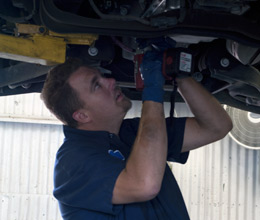
At All Around Auto Repair, a vehicle that pulls to one side is evaluated as a complete system. Technicians check alignment angles, inspect tire condition, measure tire pressure, and examine suspension and steering components to ensure the true root cause is identified and addressed. In many cases, a simple alignment correction restores proper handling and prevents further damage, allowing your steering wheel to return safely to center.
Ignoring a slight pull allows the problem to compromise other vital components of your vehicle over time. If you’ve noticed your car drifting slightly or requiring constant steering correction on flat surfaces, let our experienced team restore proper balance to your drive.
To schedule a precise laser wheel alignment or a comprehensive front-end suspension safety check, please contact All Around Auto Repair today.
📞 (707) 837-0646
📍 1244 Central Ave, Santa Rosa, CA 95401
All Around Auto Repair – Repair. Maintenance. Service. Since 2001.