For many drivers, nothing is more stressful than when a warning light pops up on the dashboard or when the car starts making an unusual sound. Your first thought might be: “How serious is this?” followed quickly by, “How much will it cost?”
At All Around Auto Repair, we know time matters just as much as money. That’s why one of the things our customers value most is how quickly we can get to the bottom of a problem. Thanks to advanced diagnostic tools, combined with years of hands-on expertise, we’re able to diagnose many issues in minutes, not hours or days.
In this article, we’ll break down how modern diagnostics work, what makes them so efficient, and why having both technology and experience matters when it comes to fixing your car right the first time.

The role of modern diagnostic tools
Today’s vehicles are more like rolling computers than simple machines. Most cars built after 1996 come with an OBD-II system (On-Board Diagnostics) that constantly monitors the health of the engine, transmission, emissions system, and more.
When something goes wrong, the system stores a code that can be read by a scanner. These diagnostic trouble codes (DTCs) give us a starting point, often identifying the general system or part that needs attention.
Examples include:
- P0300: Random/multiple cylinder misfire detected.
- P0171: System too lean (fuel-air imbalance).
- P0420: Catalyst system efficiency below threshold (possible catalytic converter issue).
With the right scanner, we can pull these codes within minutes and get immediate insight into your car’s health.
Why diagnostics are more than just error codes
Some drivers buy a handheld OBD-II reader and try to diagnose their car themselves. While this can give basic information, it often tells only part of the story.
For example:
- A misfire code may point to a spark plug, but the real problem could be a bad fuel injector or a failing head gasket.
- A catalytic converter code could mean the converter is worn out, or it could mean a sensor is faulty.
That’s where our experience comes in. We don’t just read the code, we interpret it. Our ASE-certified mechanics use the codes as a guide, then confirm with additional tests to make sure we fix the root cause, not just the symptom.

The speed advantage: Live data and advanced scanners
What sets professional shops apart is the technology we use. Our diagnostic scanners don’t just read codes, they pull live data from your car. This includes things like:
- Real-time oxygen sensor readings.
- Fuel trim data to spot efficiency problems.
- Transmission temperature and shifting behavior.
- Brake and ABS sensor readings.
This live data allows us to see how different systems interact while the car is running. Instead of waiting for a problem to show up again, we can simulate conditions in the shop and pinpoint the issue within minutes.
A step-by-step look at our diagnostic process
Here’s how a typical diagnostic visit works:
- Customer interview
We ask you what you’ve noticed, warning lights, noises, smells, or changes in performance. Your input helps us narrow down possibilities quickly. - Visual inspection
Before plugging in tools, we take a look under the hood and under the car. Sometimes the issue is obvious, like a loose hose or leaking fluid. - Code retrieval
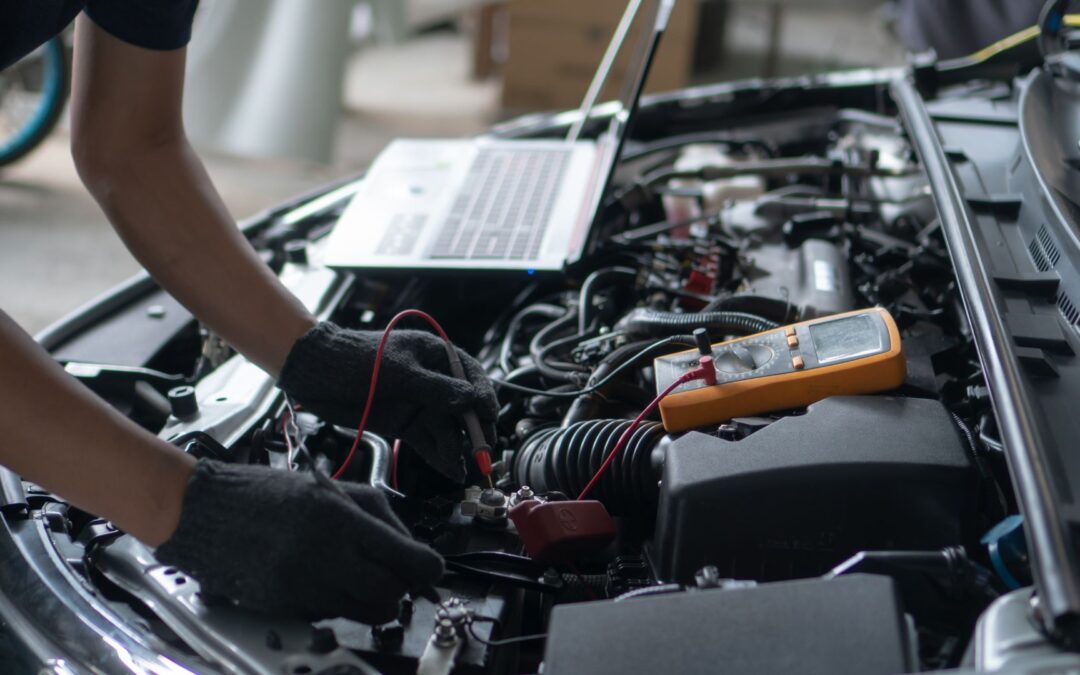
We connect a professional-grade scanner to the OBD-II port and retrieve stored codes, giving us a starting point. - Live data analysis
If needed, we monitor the car while it’s running to see how systems perform in real time. - Targeted testing
Based on the data, we may run specific tests like a vacuum test, compression test, or electrical system check to confirm. - Clear diagnosis & estimate
Within minutes, we can usually explain what’s wrong, how urgent it is, and provide an estimate for the repair.
Why quick diagnosis matters
The faster you know what’s wrong with your car, the faster you can make smart decisions. Quick diagnostics mean:
- Less Downtime: You get back on the road sooner.
- Lower Costs: Fixing the right problem the first time avoids wasted money on unnecessary parts.
- Peace of Mind: You know whether the issue is minor or urgent.
- Preventive Action: Spotting small problems early prevents them from turning into expensive repairs.
When diagnostics reveal bigger issues
Sometimes, a quick scan reveals a bigger problem, like a failing transmission or engine trouble. While no one wants bad news, catching it early makes all the difference. Instead of waiting until a breakdown on the road, you can plan repairs, weigh options, and avoid towing costs.
Why professional diagnosis beats guesswork
You could ignore that warning light and hope it goes away, or you could try swapping parts until the problem disappears. But both approaches waste time and money.
Professional diagnostics:
- Save money: No buying parts you don’t need.
- Save time: Issues are confirmed in minutes.
Save stress: You know exactly what needs attention.

Final thoughts: Minutes that save you miles
At All Around Auto Repair, diagnosing car problems quickly isn’t just about technology, it’s about combining advanced tools with years of experience. We don’t just clear codes; we solve problems.
So, the next time your check engine light comes on, your brakes feel spongy, or your car just doesn’t sound right, don’t wait. Bring it in and let us diagnose the issue in minutes, so you can get back to driving with confidence.
📞 (707) 837-0646
📍 1244 Central Ave, Santa Rosa, CA 95401
🌐 allaroundautorepair.com
Your car deserves more than guesswork. Schedule your diagnostic check today and let our team get to the root of the problem, fast.