
Most drivers expect their steering wheel to naturally return to center after completing a turn. In a properly functioning vehicle, this happens almost automatically. You make the turn, release pressure on the wheel, and the steering system naturally helps guide the wheels back toward a straight-ahead position.
When that no longer happens, it may seem like a minor annoyance at first. However, a steering wheel that fails to return to center is often an early warning sign that something within your steering rack, suspension bushings, or alignment geometry requires immediate attention.
Understanding why this happens can help you identify potential issues before they affect your vehicle’s handling, tire life, and overall safety. Modern vehicles are designed with precise chassis specifications that encourage self-centering, meaning any reluctance to snap back indicates a mechanical resistance or a breakdown in geometry.

Incorrect Caster Angles and Strut Bearing Binding
One of the most frequent reasons for poor steering return is incorrect wheel alignment. Many drivers think alignment only affects whether a vehicle pulls left or right, but it also directly dictates steering response and self-centering behavior. Technicians pay closest attention to the caster angle, which is the forward or backward tilt of the steering axis relative to a vertical line.
When caster angles move outside manufacturer specifications due to pothole impacts, hitting curbs, or normal component aging, the self-centering force is deeply reduced. Catching these geometric shifts early during your scheduled routine auto maintenance updates stops the vehicle from wandering and prevents premature tire scrubbing. Suspension and steering systems work in absolute harmony, meaning a fault in one immediately overloads the other.
Worn upper strut mounts can also lock your steering wheel out of center. The top of the front strut assembly contains a specialized thrust bearing that allows the suspension to pivot smoothly. Technical chassis studies published by SAE International reveal that when moisture and road debris seize this upper strut bearing, rotational friction spikes, physically blocking the front wheels from returning to a neutral, straight path after navigating tight corners.

Steering Rack Gear Wear and Component Corrosion
The steering rack itself can be the root source of this sticky response. Whether your vehicle utilizes a hydraulic pump or an electric power steering (EPS) motor layout, the internal pinion gear must glide smoothly across the main steering rack teeth. Over time, internal fluid contamination, broken seals, or physical gear binding can create severe mechanical resistance. If you are experiencing heavy steering effort paired with a sticky centering action, a prompt auto inspections sequence on a lift can determine if the steering rack housing is bent or binding internally.
Environmental corrosion also limits steering compliance. In areas exposed to moisture and road salt, structural joints like ball joints, outer tie rod ends, and suspension pivots experience heavy oxidation. Once the factory grease seals crack, water enters and creates internal rust. According to consumer safety profiles managed by Consumer Reports, a seized or dry ball joint can create an incredibly stiff steering axis, forcing the driver to manually muscle the steering wheel back to center to avoid drifting off the road.
Tire footprints and tire inflation pressures also heavily dictate handling feedback. Underinflated tires generate excessive rolling resistance and tread scrubbing against the asphalt, dampening the natural centering motion of the hub assemblies. Mismatched tire treads or uneven shoulder wear patterns create asymmetric lateral forces across the front axle, disrupting your steering tracking.

Unconscious Driver Adaptation and Structural Safety Risks
Because poor steering return typically develops very gradually, many drivers unconsciously adapt by making continuous small steering corrections without realizing a safety hazard exists. However, ignoring a sticky steering column is highly risky. Industry technician guidelines managed by the ASE (National Institute for Automotive Service Excellence) emphasize that driving with binding suspension links places immense strain on your tie rods and steering column couplers, which can lead to rapid tire wear or sudden component separation during emergency avoidance maneuvers. Utilizing advanced vehicle diagnostics can isolate steering angle sensor calibration errors within your power assist modules before they cause tracking fatigue.
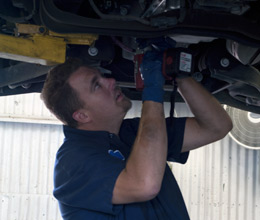
At All Around Auto Repair, our technicians evaluate steering return concerns through a comprehensive front-end inspection. We examine your wheel alignment on specialized computerized equipment, test ball joint play, verify strut bearing smoothness, and inspect your steering rack fluid paths or electrical sensor outputs to find the exact root cause of your handling complaints.
Your steering system should always respond with absolute precision, stability, and smoothness. If your steering wheel has lost its natural tendency to straighten itself out after a corner, let our experienced team diagnose the layout and restore your vehicle’s factory-fresh handling confidence.
To schedule a precise front-end alignment evaluation or a comprehensive steering rack health check, please contact All Around Auto Repair today.
📞 (707) 837-0646
📍 1244 Central Ave, Santa Rosa, CA 95401
All Around Auto Repair – Trusted Auto Repair, Steering & Suspension Service Since 2001.