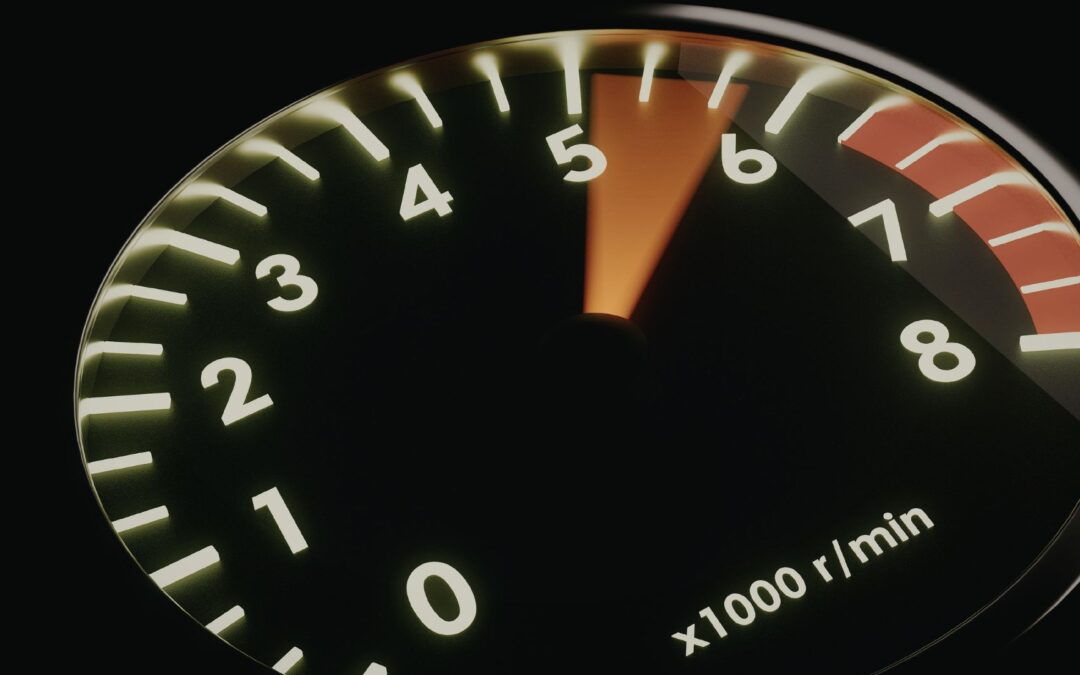
You’re stopped at a red light, foot on the brake, when you notice the tachometer behaving strangely. The RPMs rise, then drop. The engine sounds uneven. Maybe the car vibrates slightly or feels like it’s about to stall. A moment later, everything seems normal again, until you hit the next stoplight.
If your car’s RPMs jump up and down while idling, you’re not imagining it. This issue, often referred to as an unstable idle or idle fluctuation, is a common drivability problem. And while it may not always trigger a Check Engine Light right away, it’s a direct sign that something inside your intake or combustion loop is no longer operating in perfect harmony.
When your car is stopped, the engine should idle at a steady speed, usually between 600 and 900 RPM. That steady needle means the engine control module (ECM) is delivering a well-proportioned balance of air, fuel, and spark. When RPMs rise and fall at a stoplight, it means the computer is continuously trying to correct a calculation error, “hunting” for the right conditions to keep the engine from dying.

Carbon-Choked Throttle Bodies and Unmetered Vacuum Leaks
The most frequent cause of fluctuating RPMs is a dirty throttle body. The throttle body houses a butterfly plate that controls how much air enters the intake manifold. At a stoplight, this plate is nearly closed, leaving only a microscopic gap for air to pass. Over time, normal combustion byproducts and oily vapors create sticky carbon rings around the plate’s edges.
When carbon restricts this gap, the engine starves for air and the RPMs drop. The computer instantly panics, opening the plate wider to compensate, which causes the RPMs to surge upward before the cycle repeats. Resolving this oscillation requires a professional cleaning and a digital electronic reset, which can be easily scheduled alongside your routine oil changes and filter updates.
Vacuum leaks are another prime culprit. Your engine relies on a fully sealed vacuum network to track internal air volume. If a rubber hose cracks, an intake manifold gasket shrinks, or a plastic fitting becomes brittle, unmetered air enters downstream of the sensor. Technical airflow metrics monitored by SAE International confirm that vacuum leaks have their most destructive impact at low idle speeds, where the air-to-fuel margin is narrowest, causing erratic needle jumps as the computer struggles to balance the unexpected oxygen surge.
Lazy Airflow Sensors, Weak Spark, and Hydraulic Strain
The Mass Air Flow (MAF) sensor tracks air density so the ECM can accurately dose the fuel injectors. If the internal hot-wire inside the MAF sensor becomes coated in dust or oil, it reads data lazily. It won’t fail completely or trigger a dashboard light right away, but it will feed erratic flow charts to the computer, leading to mismatched fuel delivery and a bouncy idle. Isolating these lazy sensor values requires an advanced vehicle diagnostics procedure to scan live data parameters.
Ignition component wear also amplifies idle problems. At a stoplight, cylinder pressures are low, requiring a hot, instantaneous spark from your plugs and ignition coils to maintain smooth combustion cycles. If electrodes are worn or a coil is tracking weak voltage, you get micro-misfires that trigger sudden RPM drops and heavy cabin vibrations. Consumer car care updates compiled by Consumer Reports caution that ignoring a rough ignition idle eventually dumps unburned fuel into your exhaust, causing premature failure of expensive emissions components.

Fuel Inconsistency, Coolant Anomalies, and Transmission Drag
Your vehicle also requires perfectly consistent fuel pressure while resting. Partially clogged fuel injectors, a weak fuel pump armature, or a neglected fuel filter can alter line pressure. This pressure drop prevents a clean mist pattern, causing cylinder speeds to fluctuate. Furthermore, an inaccurate engine coolant temperature sensor can misinform the ECM about internal engine heat, causing the computer to cycle between warm-idle and cold-start profiles without warning.
In automatic vehicles, keeping your foot on the brake at a stoplight keeps the transmission torque converter engaged in Drive, placing a mechanical load on the engine. If a dirty intake path or aged fluids prevent the engine from managing this parastic load, the RPMs will drop sharply. Fleet dynamic summaries published by ASE (National Institute for Automotive Service Excellence) emphasize that sudden idle variations under torque converter load are often early symptoms of transmission fluid contamination, making a dedicated transmission service and repair evaluation smart preventive maintenance.

The Risk of Traffic Stalling and Professional Diagnostics
While an unstable idle may feel like a minor annoyance initially, leaving it unaddressed is risky. An engine that is hunting for equilibrium can easily stall in heavy traffic, leaving you without power steering or brake boost in dangerous merging lanes. Catching the issue early through targeted diagnostics prevents secondary soot buildup on your valves and preserves long-term driving comfort.
At All Around Auto Repair, our technicians take a systematic approach to drivability concerns. We perform comprehensive inspections—including smoke-testing for hidden vacuum leaks, monitoring MAF sensor data frequencies, checking spark plug degradation, and conducting fuel pressure tests to target the exact source of your idle instability rather than simply resetting warning codes.
Your engine is designed to run smoothly and predictably under all operating conditions. If your tachometer needle has started jumping or your car feels jittery at red lights, let our experienced team diagnose the cause and restore your vehicle’s clean, factory-smooth idle response.
To schedule a professional throttle body service or a complete engine performance evaluation, please contact All Around Auto Repair today.
📞 (707) 837-0646
📍 1244 Central Ave, Santa Rosa, CA 95401
All Around Auto Repair – Repair. Maintenance. Service. Since 2001.